The word "dichroic", pronounced Dye-Cro-Ick, is derived from two Greek roots, "di" for two and "chroma" for color. So "dichroic" literally means "two-colored."
You may hear dichroic glass referred to as "dichro" for short or even very rarely as "chameleon glass". You may also hear it incorrectly referred to as dichronic, dichrotic, dicroic, dicromic, diachronic and dichryllic just to name a few. Another misconception is that dichroic glass is the same as fused glass or refers to the entire fused glass movement. Though fused glass or warm glass may incorporate dichroic glass elements; doing so is not a requirement. Dichroic glass can be used as an element in glass blowing, bead making and of course glass fusing.
The most distinctive feature of dichroic glass is that it seems to have more than one color, especially when viewed from different angles. For example, a particular formulation will appear blue, but shift the dichroic glass slightly and the color will transition to green.
 Dichroic glass adds flash and pizazz, it adds sparkle and intrigue, but too much can be overwhelming and gaudy. For example, subtle gold highlights throughout your house can create a sense of luxury and class. Now imagine every lighting fixture, plumbing fixture, wall and switch plate in gold and you get the idea. Stacking dichro on top of black glass is easy and can look good, but one can quickly transform a unique design into something you can find almost anywhere else. It is easy to fall into the trap of depending almost entirely on dichroic glass especially in glass jewelry. However; dichroic glass can never make up for a lack of design, quality, technique and artistic effort. Artists who explore the interplay of color between the broad color palette of art glass and dichroic glass will be richly rewarded with an incredible spectrum of possibilities. Making dichroic glass is rocket science, exploring its endless possibilities, that's art!
 Adding to its complex optical properties, dichroic glass when fused as part of a glass object or piece of jewelry will change characteristics yet again with the new colors shifting towards the blue end of the spectrum.
The manufacture of dichroic glass is not a DIY project. The equipment and effort required to make dichroic glass is expensive meaning that a sheet of dichroic glass is itself expensive costing up to hundreds of dollars wholesale.
 The deposited oxides have no intrinsic color themselves, instead it is the physical properties of the metallic oxides in the dichroic glass that cause different wavelengths of light to either reflect or transmit more than others. These properties cause certain light waves to be reflected while others travel through the glass along slightly different paths thus causing the color shift we observe. Most dichroic glass uses both transmission and reflection of light to achieve the desired effect so that as you rotate a piece of dichroic glass, even slightly, you'll see shifting rainbow of colors. The physical properties that determine the final effect include the type of oxide (like silicon, titanium or magnesium), the number of oxides used, the order, number and thickness of layers, and the pattern (like hearts, dots, squares, etc.). With so many variables, dichroic glass presents an incredibly rich and varied palette of colors and patterns for glass artists to work with.
 Dichroic glass requires complex processes which have been mastered by a handful of manufacturers. The limited supply is partially due to the requirement for very high-tech equipment. Dichroic glass is created by vaporizing various metallic oxides in a vacuum chamber, using a high-voltage electron beam, and allowing the molecules to be deposited onto the surface of a blank sheet of usually clear or black glass. Careful control (using computers) of time and temperature determines the thickness of the oxide deposited on the glass. The complete process may require from 15 to 50 distinct layers (steps) of alternating metallic and silicon oxides. The total thickness of the oxide layers may total no more than 70 nanometers (700 angstroms). To put things in perspective, a human hair is 70 microns, or 1000 times thicker than the total oxide layer in dichroic glass. For further perspective, the wavelength of visible light ranges from 400 nanometers (the color violet), to 700 nanometers (the color red). The dichroic coating creates an optical filter that transmits (passes) certain wavelengths of light and reflects (blocks) others.

You may hear dichroic glass referred to as "dichro" for short or even very rarely as "chameleon glass". You may also hear it incorrectly referred to as dichronic, dichrotic, dicroic, dicromic, diachronic and dichryllic just to name a few. Another misconception is that dichroic glass is the same as fused glass or refers to the entire fused glass movement. Though fused glass or warm glass may incorporate dichroic glass elements; doing so is not a requirement. Dichroic glass can be used as an element in glass blowing, bead making and of course glass fusing.
The most distinctive feature of dichroic glass is that it seems to have more than one color, especially when viewed from different angles. For example, a particular formulation will appear blue, but shift the dichroic glass slightly and the color will transition to green.


The manufacture of dichroic glass is not a DIY project. The equipment and effort required to make dichroic glass is expensive meaning that a sheet of dichroic glass is itself expensive costing up to hundreds of dollars wholesale.
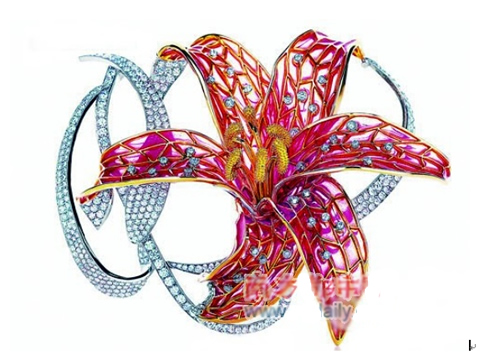


Dichroic glass adds flash and pizazz, it adds sparkle and intrigue, but too much can be overwhelming and gaudy. For example, subtle gold highlights throughout your house can create a sense of luxury and class. Now imagine every lighting fixture, plumbing fixture, wall and switch plate in gold and you get the idea. Stacking dichro on top of black glass is easy and can look good, but one can quickly transform a unique design into something you can find almost anywhere else. It is easy to fall into the trap of depending almost entirely on dichroic glass especially in glass jewelry. However; dichroic glass can never make up for a lack of design, quality, technique and artistic effort. Artists who explore the interplay of color between the broad color palette of art glass and dichroic glass will be richly rewarded with an incredible spectrum of possibilities. Making dichroic glass is rocket science, exploring its endless possibilities, that's art!

No comments:
Post a Comment